Live agent, free to try
LinkedIn Thought Leadership Post
A lead editor briefs a team of specialists and decides who works next, until there's a post worth putting your name to: a real point of view, sourced, and in your voice.
- My role
- Designed the editor, the six specialists, their briefs and the review standards
- The team
- A lead editor with a trend scout, researcher, angle strategist, ghostwriter, critic and finisher
- Made as
- A lite version of an agent I designed at gimmefy
- Try it
- Live version
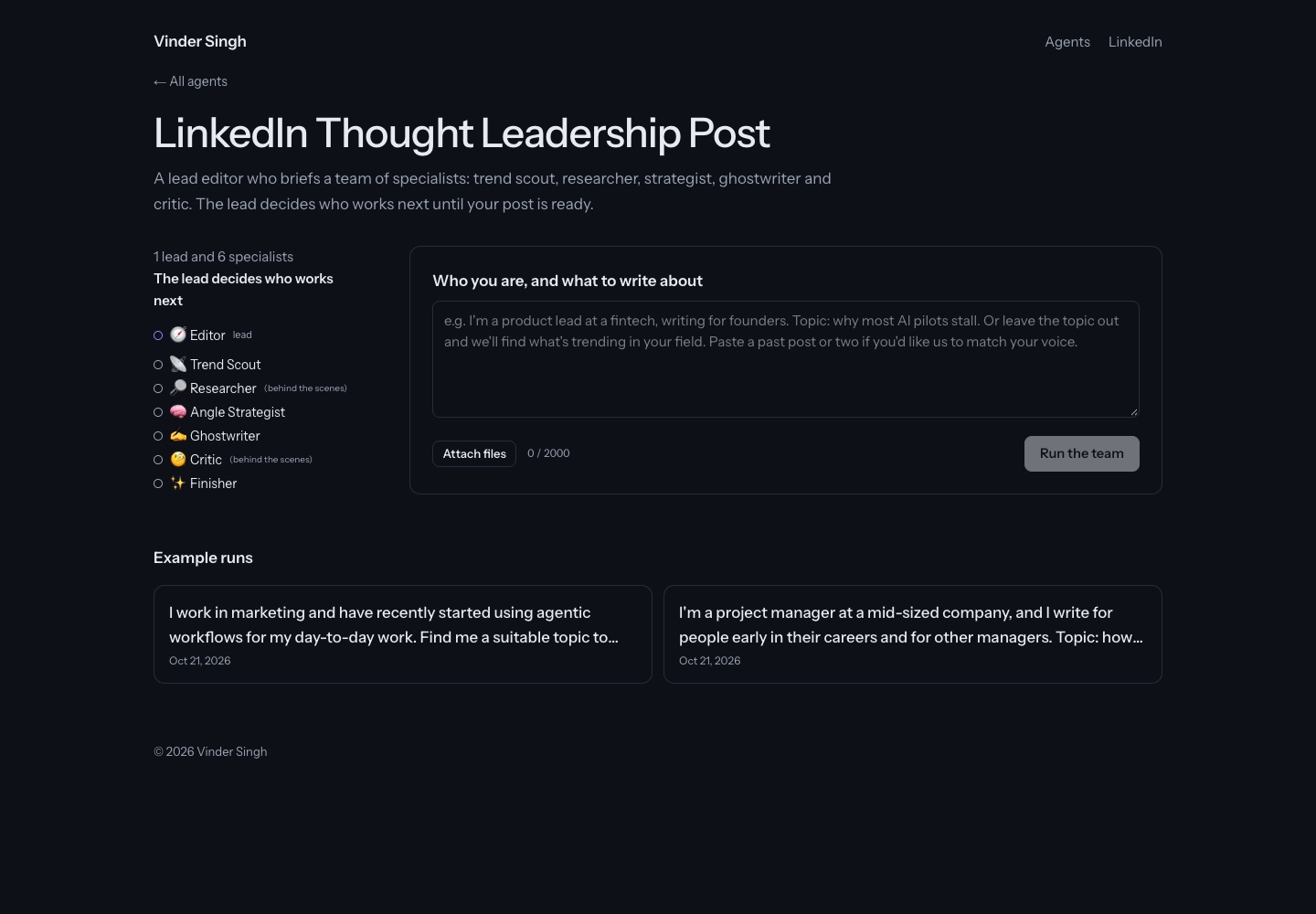 Live · Click to try
The problem
You can spot an AI-written LinkedIn post in one line. Confident and vague, a made-up anecdote, a statistic with no source, and a question at the end begging for comments.
The posts worth reading do the opposite. They take a position, back it with evidence, deal with the best argument against it, and admit what the author doesn't know.
How it works
It isn't a fixed production line. The editor reads the brief and decides who works next, the way a real editor runs a desk.
- Trend scoutOnly called when you haven't picked a topic. Finds three timely topics from the last two weeks of news in your field.
- ResearcherFacts, numbers and named examples, each sourced and dated, plus the strongest counter-argument.
- Angle strategistThree different points of view you could take, and what each one risks. You pick one.
- GhostwriterWrites the post in your voice, using only what you told it.
- CriticPasses the draft or sends it back with up to five specific fixes.
- FinisherThe final post, two alternative opening lines, a first comment with the sources, and hashtags.
Key decisions
An editor, not a pipeline
A brief with a topic skips the trend scout. A weak draft goes back to the ghostwriter. The route is decided on every run, so nobody does work the post doesn't need.
The counter-argument is part of the research
The researcher has to bring the best case against your view. A post that has already dealt with the obvious objection is far harder to dismiss in the comments.
No invented experiences
The ghostwriter can only use what you gave it. If a line would need a story you never told, it doesn't get written.
The critic has standards, not opinions
Every fact sourced and dated, no engagement bait, nothing left in that only makes sense to the author. In one example run it caught a vague source date, a personal claim the author never made, and a bait question at the end. All three were fixed before the author saw a draft.
What it produced
Read both runs, start to finish: a marketer new to agentic workflows, with no topic given and a project manager on meetings people don't dread.