Live agent, free to try
Focus Group
Put an idea, ad or pitch in front of six believable strangers. Hear their honest first reactions, get a sharper version, then see if it actually landed.
- My role
- Designed the team, the panel rules, the scoring and the guardrails
- The team
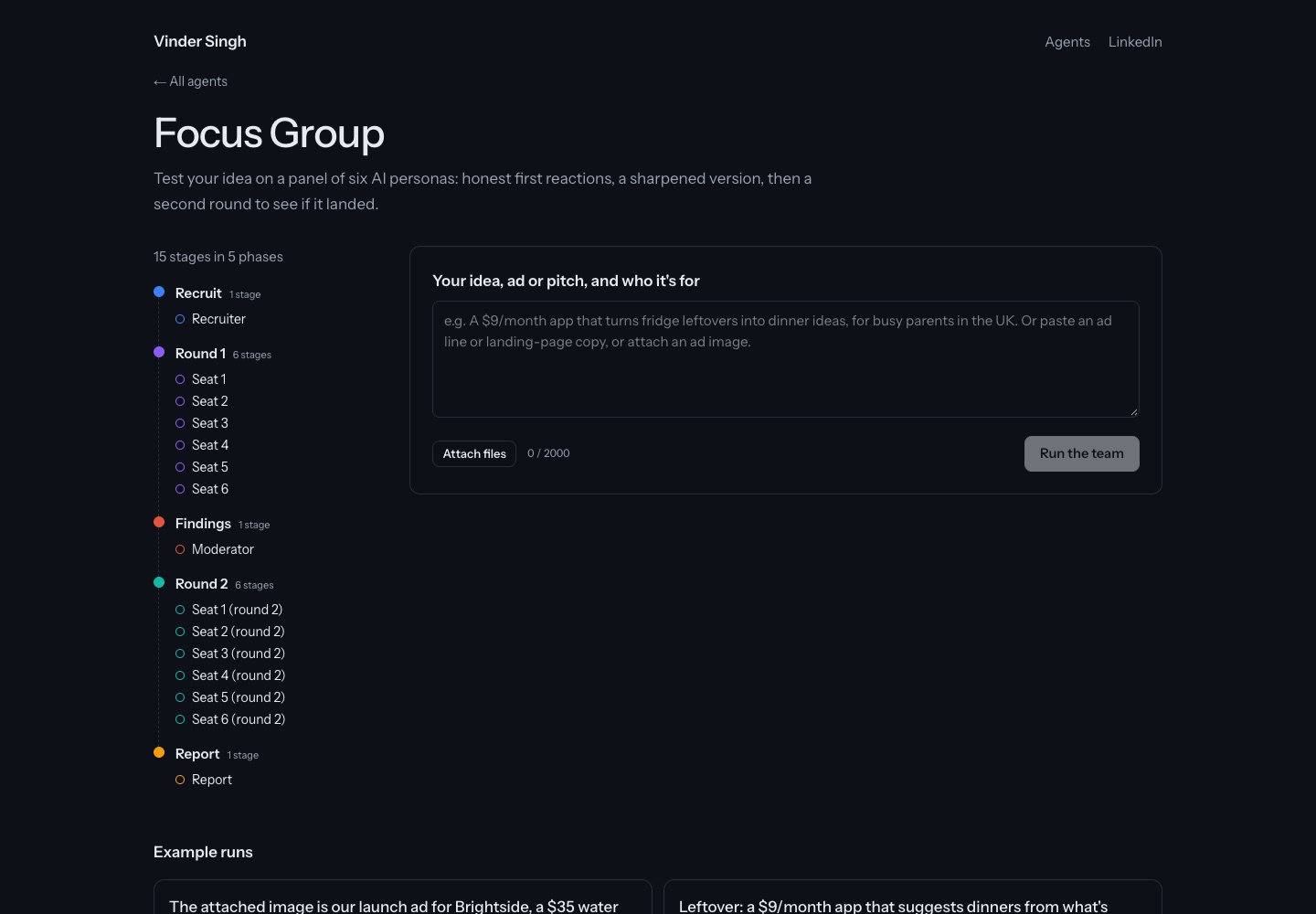
- A recruiter, six panel seats, a moderator and a report writer. 15 stages in 5 phases.
- Made as
- A lite version of an agent I designed at gimmefy
- Try it
- Live version
 Live · Click to try
The problem
Real focus groups take weeks and a budget, so most ideas reach the market tested only by the people who made them. Those people are the worst judges, because they already love it.
Teams need a fast first read that is willing to disagree with them, tells them why, and shows them what to fix before they spend money finding out the hard way.
How it works
- RecruitA recruiter builds six personas for your audience, each with a life, a habit in the category and a bias. You approve the panel or swap people out.
- Round 1All six react side by side: first reaction, what confused them, what would change their mind, and a score out of 10.
- FindingsA moderator pulls out where they agreed, where they split and the top three objections, then writes a sharper version. You confirm any facts it needs.
- Round 2The same six see the sharper version and score it again, saying what moved them and what didn't.
- ReportBefore-and-after scores, the objections still standing, the risks, and a plan for checking it with real people.
Key decisions
Disagreement is built into the panel
Every panel has a sceptic, a price-sensitive buyer and someone just outside the target. Six people who like your idea teach you nothing.
Each seat answers alone
The six reactions are written separately, at the same time, so nobody follows the loudest voice in the room. The moderator only sees them once they're all in.
It never pretends to be real research
Every stage says the panel is made-up personas giving informed guesses. Product facts the moderator can't confirm stay in brackets, and the report ends by telling you who to interview for real.
You stay in charge
The team stops twice for you: to approve the panel before anyone reacts, and to check the facts before round two.
What it produced
In one example run, a launch ad for a $35 glowing water bottle went from an average of 4.0 to 5.3 out of 10. Explaining how it charges and adding a 30-day return did most of the work. But the sceptic barely moved and the price gap never closed, and the report says so. What didn't move is the most useful part.
Read both runs, start to finish: Brightside, a glowing water bottle ad and Leftover, a fridge-photo dinner app.